BYD is one of the fastest-growing EV brands in Saudi Arabia, and new owners keep asking the same question: which home charger fits my car, and do I need 7 kW or 11 kW? This guide answers it for each BYD model sold in the Kingdom and explains what a proper home installation involves, so you buy the right charger the first time.
The charging port on GCC-spec BYDs
All BYD electric models officially sold in Saudi Arabia and the GCC use a Type 2 port for AC home charging and CCS2 for DC fast charging at public stations. Any compliant Type 2 wallbox will physically fit your BYD.
AC charging capacity for each BYD model
The car's onboard charger caps AC charging speed, not just the wallbox. A more powerful wallbox cannot go past your car's limit. Here are the main figures for the models sold in Saudi Arabia:
Approximate charging capability of BYD models in Saudi Arabia
| Model | Approximate battery | Max AC charging | Approximate time from 20 to 100% |
|---|---|---|---|
| BYD Atto 3 | 60 kWh | 7 kW | about 7 hours |
| BYD Seal | 61 to 82 kWh | 11 kW | 4.5 to 6 hours |
| BYD Han | 85 kWh | 11 kW | about 6 hours |
| BYD Sealion 7 | 82 kWh | 11 kW | about 6 hours |
| DM-i hybrids such as the Song Plus and Qin Plus | 18 to 26 kWh | 3.3 to 6.6 kW | 3 to 6 hours |
These figures come from the manufacturer's published specifications and can vary by model year and trim. Check your car's manual or ask our technical team before buying.
How to choose between 7 kW and 11 kW
Two things decide it: your car's AC limit and your home's electrical supply. A 7 kW charger runs on the single-phase 230 V supply found in most apartments and villas. An 11 kW charger needs a three-phase 400 V supply.
- If you drive an Atto 3 capped at 7 kW, a 7 kW charger is all you need. A bigger unit adds no speed.
- If you drive a Seal, Han or Sealion capped at 11 kW and your home has three-phase supply, an 11 kW charger cuts charging time noticeably.
- If you plan to add a second EV later, consider an 11 kW unit or a panel that is ready for an upgrade from day one.
Either way, overnight charging at home covers typical daily driving. Even a 7 kW charger adds about 40 to 50 km of range per hour.
Portable charger vs wallbox
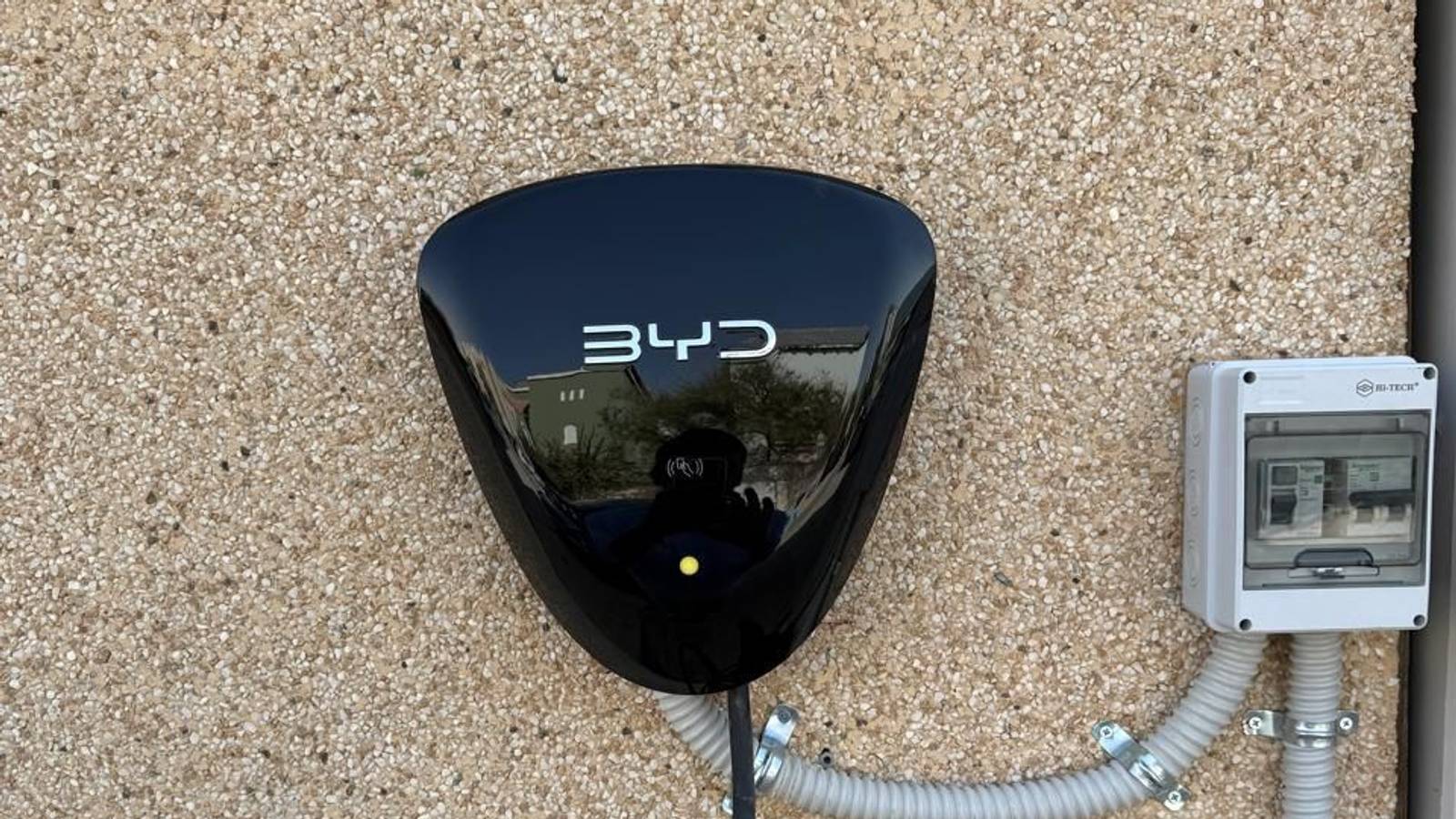
Some BYDs come with a portable emergency charger that plugs into a regular socket. It charges slowly, at around 2 kW, and daily use can strain household wiring. A wall-mounted charger on its own dedicated breaker is the safe daily option, and its app lets you schedule charging and track consumption.
What does installation involve in a Saudi home?
A proper installation starts with a load study to confirm your distribution board can take the extra demand. Then the installer runs a dedicated circuit with its own breaker and earth-leakage protection, following the Saudi Building Code and utility requirements. Our step-by-step guide to home EV charger installation in Saudi Arabia covers the full process.
- A technical site survey to choose the mounting point near your parking spot.
- A dedicated line from the main panel with its own breaker and earth-leakage protection.
- A certified Type 2 wallbox compliant with Saudi standards.
- Commissioning with your own car, app handover, and warranty.
Does any Type 2 charger work with a BYD?
Electrically, yes. The difference between chargers is quality and certification. Choose a known brand with international safety certifications and Saudi compliance, rated to match your car's limit. At Climatech Charger we supply and install chargers from brands we are authorised partners for, such as Schneider Electric and ABB, with a warranty that covers both the unit and the installation.
Own a Lucid, or comparing the two brands? Read our guide to BYD and Lucid chargers in Saudi Arabia.
Ready to install your home charger?
The Climatech Charger team installs charging points across the Kingdom, in residential villas, banks and hotels. We help you pick the right capacity for your BYD and handle the full installation to Saudi Electricity Company standards.