If you are thinking about buying an electric vehicle or have recently acquired one, you have almost certainly come across the terms "AC charging" and "DC charging" without fully understanding the difference between them. Do I need an AC or a DC charger at home? Why is fast charging on the road more expensive? And does fast charging really damage the battery?
In this simplified technical article, we explain how each type of charging works, compare them in terms of speed, cost, and optimal use, and help you make the right decision based on your actual needs.
How Does AC (Alternating Current) Charging Work?
The electricity reaching your home or workplace from the distribution grid is Alternating Current (AC). However, an EV battery cannot store alternating current directly; it needs Direct Current (DC) to charge its cells.
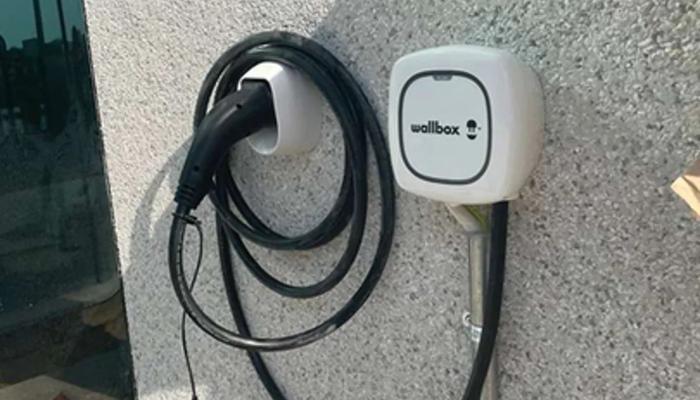
This is where the On-board Charger (OBC) inside the vehicle comes in. When you connect your car to an AC charger, the on-board charger receives the alternating current from the charger and converts it into direct current before feeding it to the battery. This converter is built into the car and has a limited capacity that varies from one vehicle to another:
- 7 kW (32 A, single-phase): the common rating in most economy and mid-range EVs
- 11 kW (16 A, three-phase): available in many European and Korean vehicles
- 22 kW (32 A, three-phase): found in luxury vehicles such as some Mercedes, BMW, and Renault models
The key point here is that AC charging speed is governed by the capacity of the on-board charger in the vehicle, not just by the capacity of the charger itself. Even if you install a 22 kW AC charger, if your car only supports 7 kW, your charging speed will never exceed 7 kW.
AC charging in a nutshell: The external charger delivers alternating current to the vehicle, and the on-board charger inside converts it to direct current. Speed is limited by the capacity of the on-board charger (typically 7 to 22 kW), which is why this type is known as slow or semi-fast charging.
How Does DC (Direct Current) Charging Work?
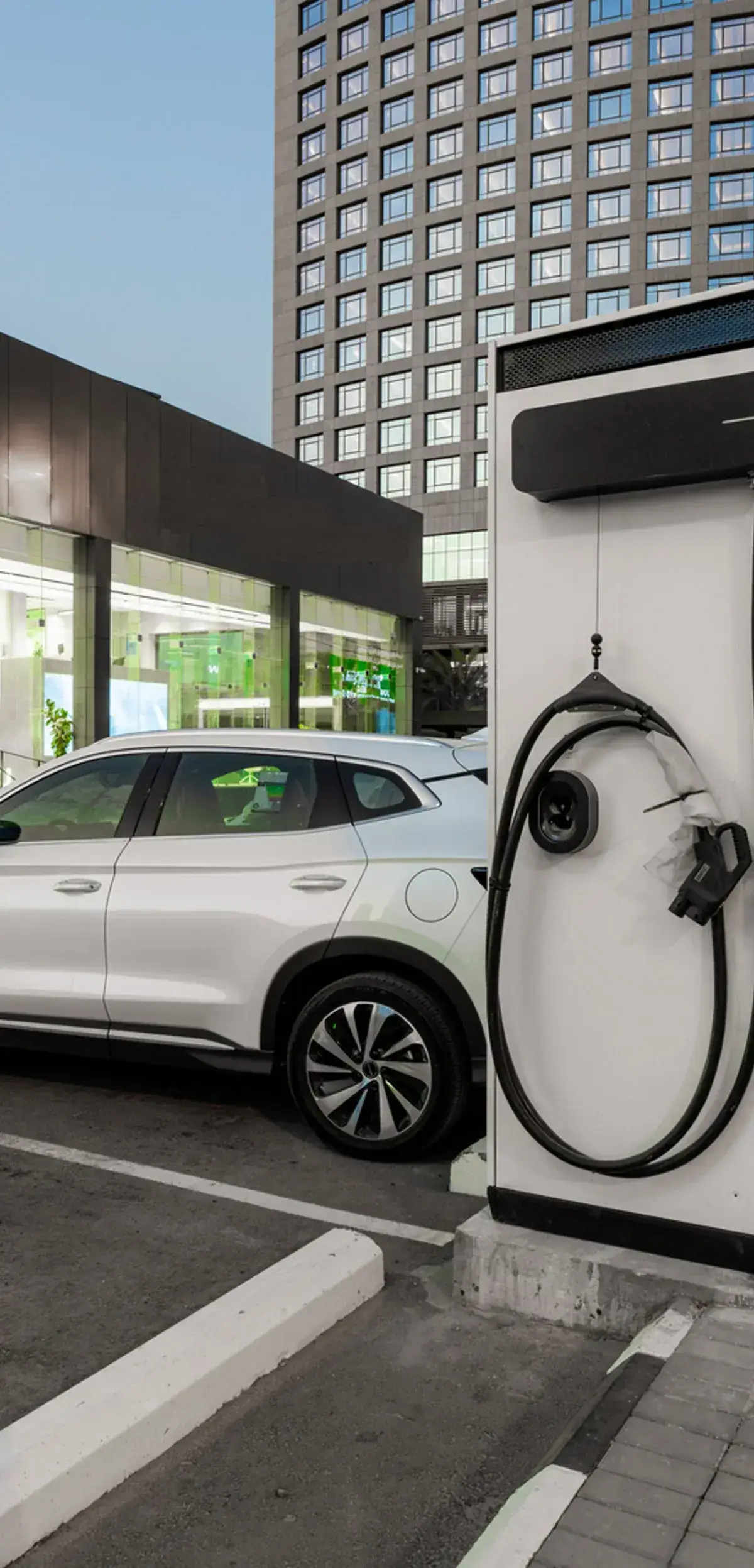
DC charging follows a completely different principle. Instead of relying on the small on-board charger inside the vehicle, the DC charger itself contains large, powerful power converters that convert the alternating current coming from the grid into high-power direct current. This direct current is then fed straight into the vehicle's battery, bypassing the on-board charger entirely.
Because the converter in a DC charger is external and is not constrained by the size and weight limits of an on-board charger, it can be designed with very high capacity. DC charger ratings in the Saudi market today range between 50 and 360 kW, up to 50 times the capacity of a home AC charger.
When the vehicle is connected to a DC charger, a communication protocol begins between the charger and the vehicle's Battery Management System (BMS). The BMS tells the charger the required voltage and current, the battery temperature, and the current state of charge, and the charger adjusts its output accordingly in real time. This precise coordination ensures safe and efficient charging without damaging the battery cells.
DC charging in a nutshell: The external charger handles the conversion and delivers ready-to-use direct current straight to the battery. The power is not limited by the car's on-board charger, so speeds are much higher (50 to 360 kW), which is why this is known as fast and ultra-fast charging.
Charging Speed Comparison for the Most Popular EVs in Saudi Arabia
Actual charging speed depends on several factors: the charger's power, the on-board charger's capacity (in the case of AC), the maximum DC charging speed the vehicle supports, the battery's state of charge, and its temperature. The following table compares approximate charging times for some popular vehicles in the Kingdom:
As you can see from the table, the difference in time is enormous. A vehicle that needs more than 6 hours on an AC charger can be charged in less than 20 minutes on an ultra-fast DC charger. But this does not mean that DC charging is always better; each type has its ideal use case, as we will see.
Total Cost Comparison: Purchase, Installation, and Operation
The cost gap between AC and DC chargers is very large, and this is what determines where each type is used:
DC Charger Cost
Clearly, a DC charger is a commercial investment, not a personal one. There is no point installing a DC charger at home, but it is a profitable investment at a fuel station or commercial complex serving dozens of vehicles a day.
When Should You Choose an AC Charger?
An AC charger is the ideal choice in the following cases:
- Home charging: You install a 7 or 11 kW charger in your home garage or villa and plug in your car every night. You wake up in the morning with a full battery. This is the cheapest and best way to charge your car daily
- Office and corporate parking: An employee spends 8 or more hours at work, which is enough time to fully charge the battery on an AC charger
- Hotels and serviced apartments: The guest spends at least a full night, and an AC charger is enough to fully charge their car while they sleep
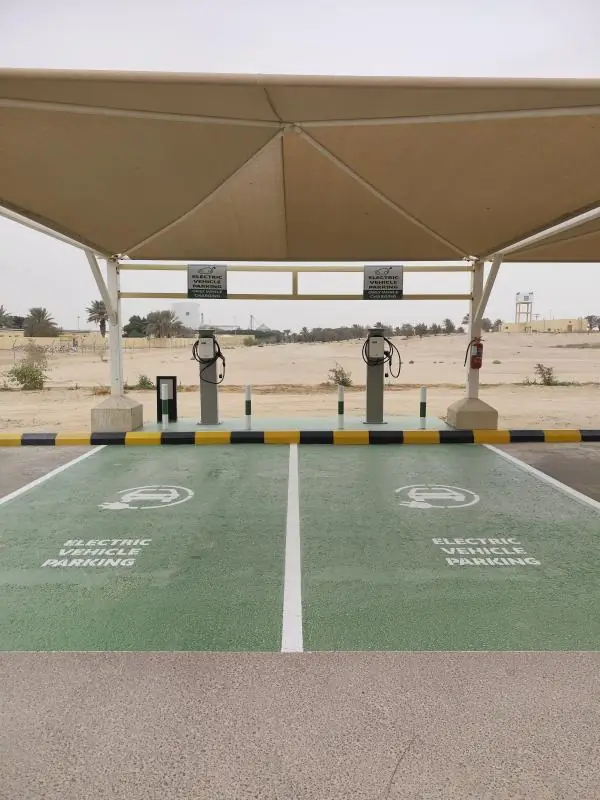
- Long-stay parking: Airports, hospitals, and universities, where the vehicle stays parked for many hours
- Residential compounds: Where each resident needs their own charging point at a reasonable cost
When Should You Choose a DC Charger?
A DC charger is the ideal choice in cases that require high charging speed:
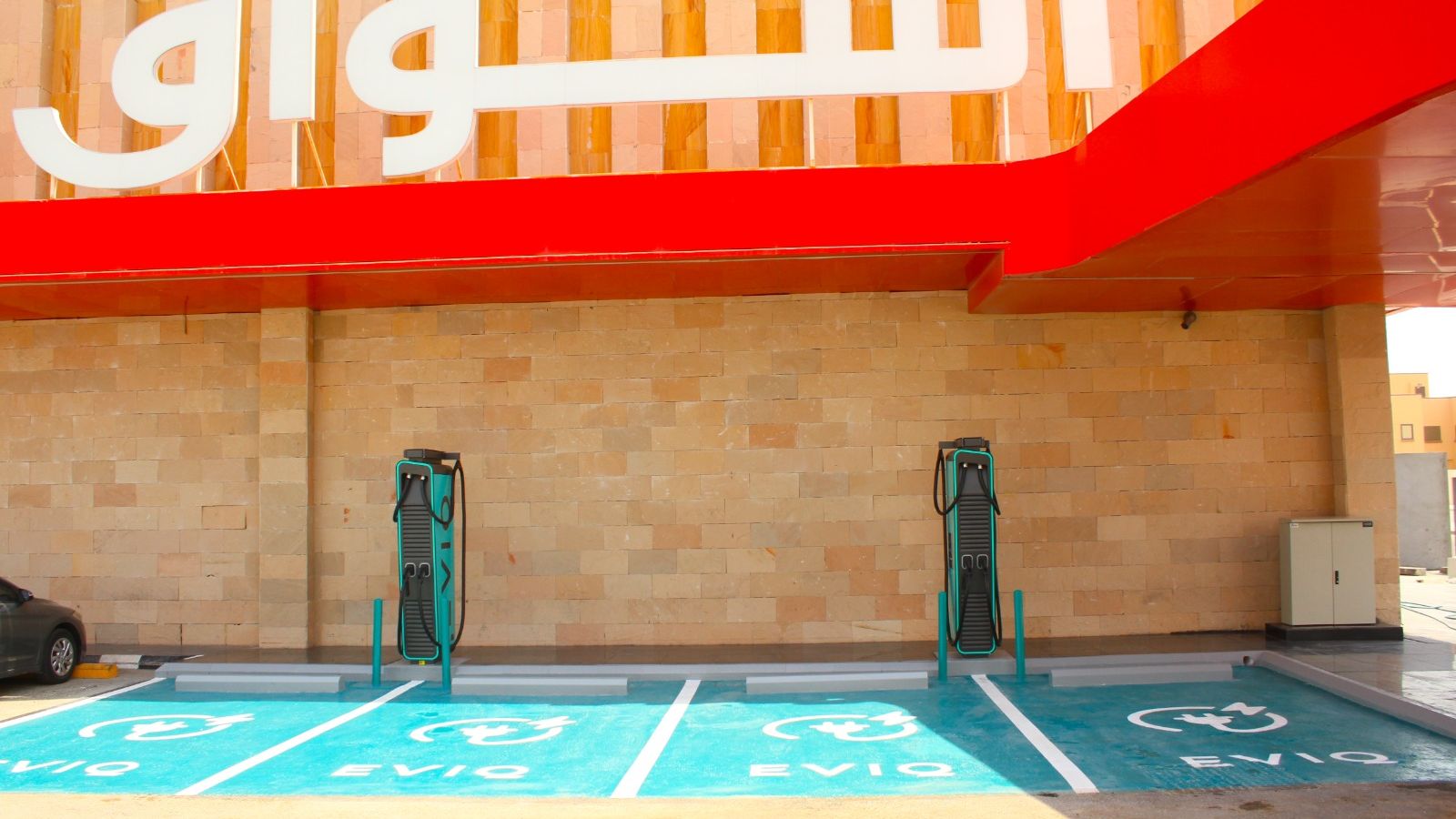
- Fuel stations: The customer wants to charge their vehicle in the shortest possible time and leave, exactly like filling up with petrol
- Intercity highways: The traveler needs a quick charge to continue their trip without a long wait
- Commercial fleet depots: Delivery trucks need fast charging between shifts so they can get back on the road as quickly as possible
- Major commercial complexes (as a premium service): Installing a limited number of fast DC chargers alongside AC chargers gives shoppers the option to fast-charge if they are short on time
- Service and maintenance centers: To test and quickly recharge vehicles after servicing
Connector Types in Saudi Arabia
In the Kingdom of Saudi Arabia, the European standards for EV charging connectors have been adopted:
Type 2 - for AC Charging
This is the standard connector for AC charging in Saudi Arabia and Europe. It supports single-phase charging (up to 7.4 kW) and three-phase charging (up to 22 kW). All EVs officially sold in the Kingdom support this connector. It has a round shape with 7 pins and features a mechanical locking system that prevents the cable from being disconnected during charging for safety reasons.
CCS2 (Combined Charging System 2) - for DC Charging
This is the standard connector for DC fast charging. It is an extension of the Type 2 connector, with two additional pins at the bottom dedicated to high-power direct current. It supports charging rates of up to 350 kW and includes a digital communication protocol between the charger and the vehicle to ensure safety during charging. All modern EVs in Saudi Arabia support CCS2 for fast charging.
Important note: Modern Tesla vehicles sold in the region now support the CCS2 connector directly. Older models that used Tesla's proprietary connector can use an adapter to charge from CCS2 stations.
The Impact of Charging Type on Battery Health
This is one of the most common questions among EV owners. The short answer: yes, DC fast charging stresses the battery more than AC charging, but the impact is less than many people imagine.
During DC fast charging, a large current flows into the battery cells, raising their temperature. High temperature is the number one enemy of lithium-ion batteries, as it accelerates the side chemical reactions that reduce battery capacity over time. That is why the Battery Management System (BMS) automatically slows down the charging speed when the temperature rises or when the state of charge exceeds 80%.
AC charging, on the other hand, uses a relatively low current, which means only a small rise in temperature and less stress on the battery cells. That is why most car manufacturers recommend that home AC charging be the primary charging source, and that DC fast charging be used only for travel and exceptional situations.
Recent studies have shown that a vehicle that relies exclusively on DC fast charging loses an additional 1% to 2% of battery capacity per year compared with a vehicle that relies primarily on home AC charging. The golden rule recommended by experts is that DC fast charging should not exceed 20% of all charging sessions.
The Future: Bidirectional Charging (V2G)
Bidirectional charging technology (Vehicle-to-Grid, or V2G) represents the next frontier in the evolution of EV charging. The idea is simple but revolutionary: instead of the vehicle being only an energy consumer, it becomes capable of exporting the energy stored in its battery back to the grid or to the home whenever needed.
Imagine this scenario: you charge your car at night when electricity prices are low, and then during peak hours in the evening your car powers your home with electricity from its battery. Or, in a power outage, your car becomes a backup generator that powers your home's essential appliances for hours or even days.
This technology requires special bidirectional chargers, which are available today in some models such as the Nissan Leaf, Hyundai IONIQ 5, and Kia EV6. It is expected to become a standard feature in most EVs over the next few years.
In the context of Saudi Arabia, V2G technology is particularly important given the high electricity demand during summer peak hours. Millions of EV batteries could form a distributed energy storage network that helps balance supply and demand.
Conclusion: Which Type of Charging Do You Need?
The simple answer: you need both, but in different proportions. AC charging is your daily companion for overnight home charging and workplace charging, and DC charging is your ally for travel and exceptional situations. Make 80% of your charging AC and 20% DC, and you will enjoy the best ownership experience with your EV while keeping your battery healthy for as long as possible.
And if you are an investor or business owner, understanding the difference between the two types helps you choose the optimal mix for your project: AC chargers for long-stay parking, and DC chargers for quick service. Climatech Charger offers both types in a wide range of capacities, starting from 7 kW AC and up to 360 kW DC, along with custom design solutions tailored to each type of project.
Do You Need a Consultation to Choose the Right Charger Type for Your Project?
The Climatech Charger engineering team will help you determine the optimal mix of AC and DC chargers based on the nature of your site and the expected number of users