Saudi Arabia targets 150 million visitors by 2030 (70 million international and 80 million domestic) under the official Vision 2030 program, after surpassing the original 100-million target six years ahead of schedule. In 2025, the Kingdom welcomed 122 million visitors, growing 5% year-on-year.
This tourism growth is putting steady pressure on hotel infrastructure — including parking. With electric vehicle adoption accelerating across Saudi Arabia, providing EV charging at hotels is no longer just a competitive amenity. It is a legal requirement set by the Ministry of Municipal, Rural Affairs and Housing (MOMRAH).
The legal requirement: 5% of hotel parking
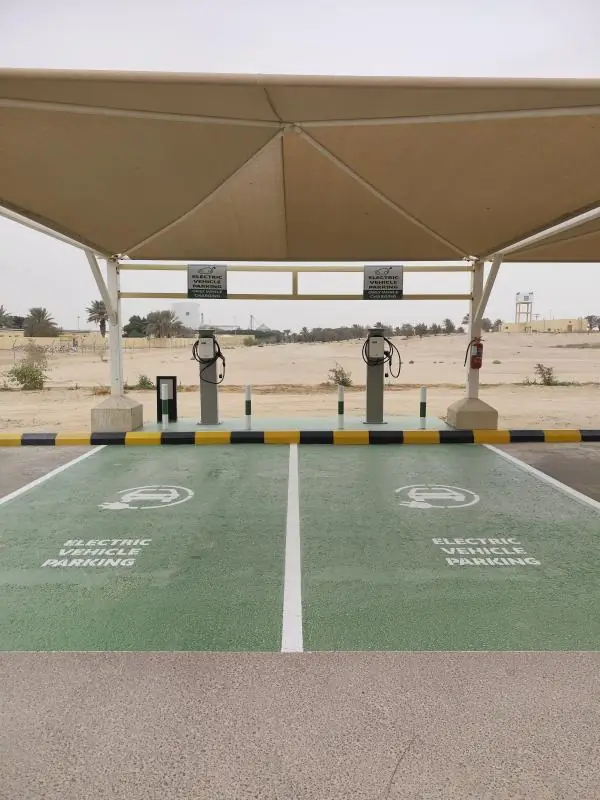
In 1442H (2020 G), MOMRAH issued technical requirements for electric vehicle charging, formally adopted in August 2022. The requirements state that 5% of parking spaces in selected public and private locations — including hotels, malls, and fuel stations — must be dedicated to EV charging.
MOMRAH classifies parking into three categories:
- Long-hour parking: hotels, theaters, commercial complexes — vehicles parked for several hours.
- Long-period parking: residential buildings, train stations — full day or longer.
- Short-hour parking: commercial streets, fuel stations — under one hour.
Hotels fall under long-hour parking — the category best matched to medium-speed AC chargers that fully recharge a guest's car overnight, with optional fast DC chargers for transient guests.
Charger types that fit hotels
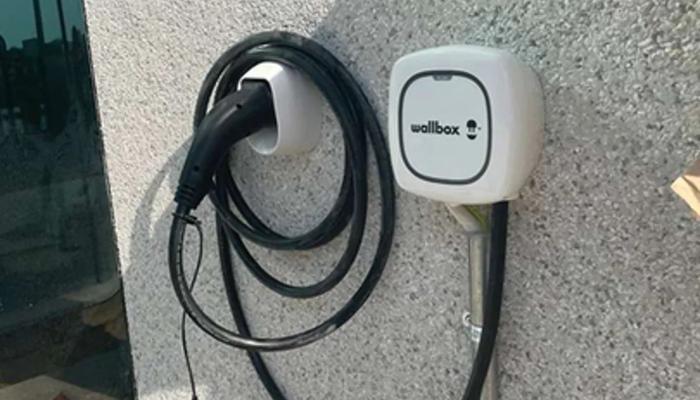
Medium-speed AC chargers (3.7 to 22 kW)
These match the basic hotel use case: a guest checks in for an evening and stays at least one night. Per international standard IEC 61851, an 11 kW AC charger can recharge a typical EV battery (50–70 kWh) from 20% to 90% in roughly 5 to 7 hours — a single overnight cycle.
DC fast chargers (40 to 360 kW)
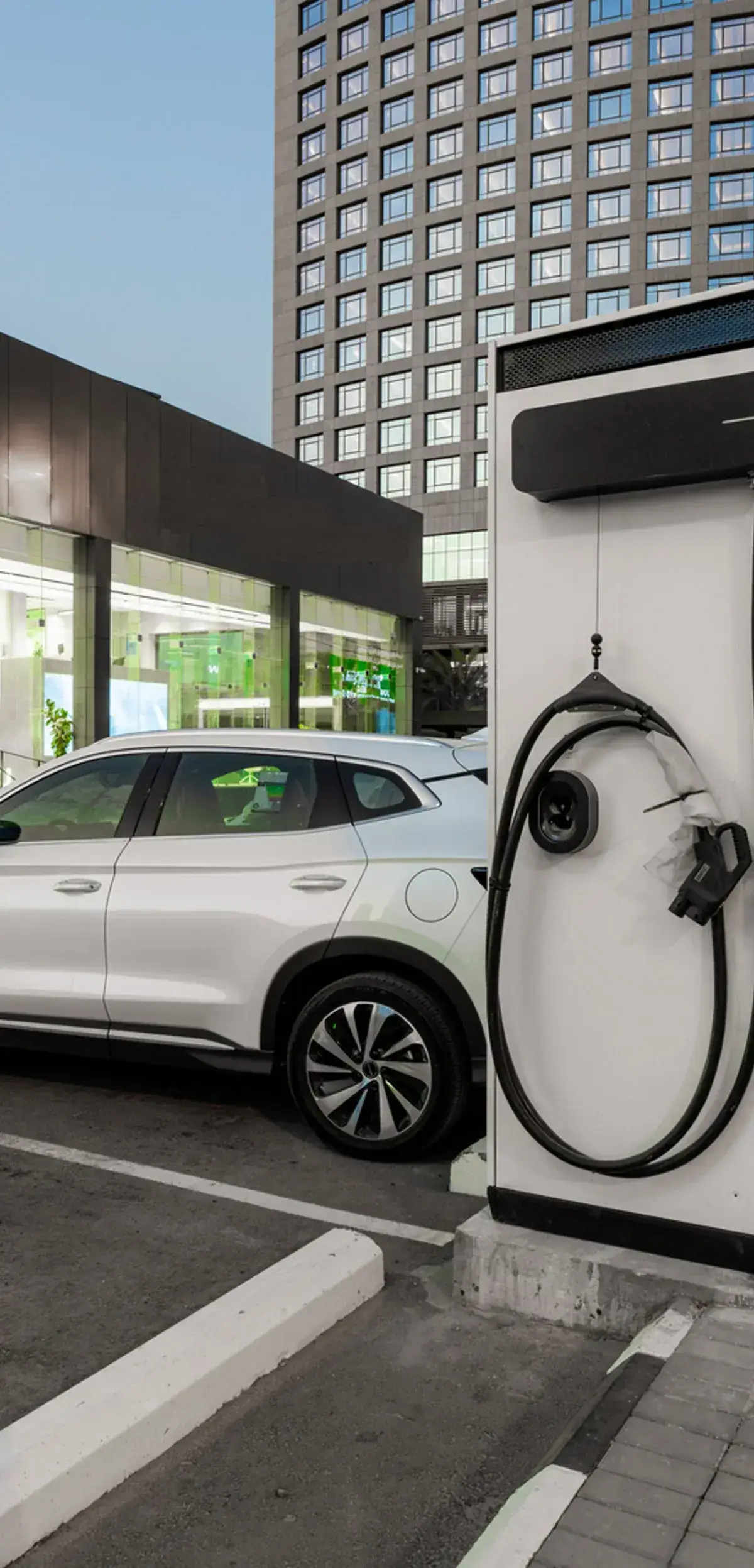
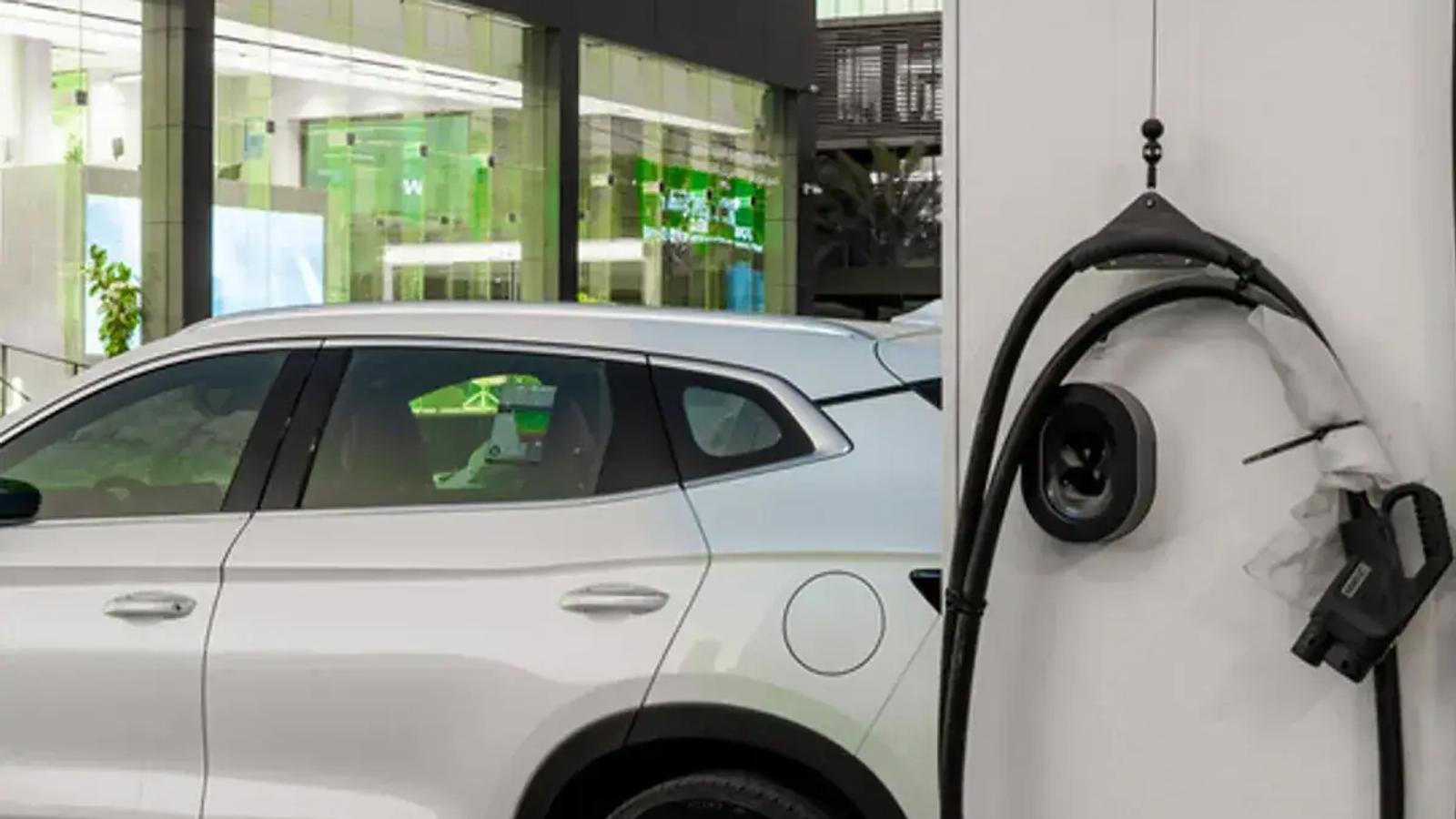
Used by hotels with transient guests, highway hotels, or properties serving short business trips. A 60 kW DC charger can recharge the same vehicle from 20% to 80% in 30 to 45 minutes.
Selection matrix: hotel type × charger type
Resort hotels (long stays): ✓✓✓
City business hotels: ✓✓ — ✓
Highway hotels: ✓ — ✓✓ — ✓
Conference hotels (day guests): ✓ — ✓✓
Airport hotels: ✓✓ — ✓
The exact count of each type depends on total parking and the MOMRAH 5% mandate.
Operating cost: commercial electricity tariff
The Saudi Electricity Regulatory Authority (SERA) sets the Kingdom's commercial tariff as follows:
VAT of 15% is added to the total bill, per the Zakat, Tax and Customs Authority (ZATCA).
Worked example (mid-size hotel)
Assume a hotel running 4 AC chargers at 22 kW averaging 8 hours of use per day:
- Daily consumption: 4 × 22 × 8 = 704 kWh
- Monthly consumption: 704 × 30 = 21,120 kWh
This is the operating cost before any revenue the hotel may collect from charging fees.
Compliance standards
Any EV charging project at a hotel falls under multiple standards:
- Electrical approval: coordination with Saudi Electricity Company (SEC) for new loads, especially for DC chargers.
- SASO certification: every installed charger must carry certification from the Saudi Standards, Metrology and Quality Organization.
- MOMRAH requirements: 5% parking allocation plus spatial and technical compliance.
- Connector standards: Type 2 (per IEC 62196-2) and CCS2 for fast charging are the primary standards adopted in the Kingdom.
- Saudi Building Code: governs the electrical and civil works.
CPMS and OCPP: managing the chargers
A Charge Point Management System (CPMS) lets the hotel:
- Monitor each charger's status in real time
- Generate usage and revenue reports
- Configure pricing (free for guests, or paid)
- Receive automated maintenance alerts
- Integrate billing into the hotel's financial system
The standard protocol between charger and CPMS is OCPP (Open Charge Point Protocol) version 1.6J or 2.0.1 — an open standard from the Open Charge Alliance.
Choosing an OCPP-compliant charger preserves the hotel's option to switch CPMS providers in the future without replacing the hardware.
Implementation considerations
A hotel EV charging project moves through several stages:
1. Site assessment
- Evaluating the hotel's existing electrical capacity
- Locating chargers (near parking, near distribution boards, away from guest movement bottlenecks)
- Assessing parking structure (open, covered, underground)
2. Civil works
- Cable trenching
- Sub-distribution panels
- Protective canopies for outdoor chargers
- Floor markings for dedicated EV bays
3. Electrical installation
- Charger connection
- Dedicated breakers
- Electrical safety testing
4. Commissioning
- Final SASO-aligned inspection
- CPMS connection and communication test
- Hotel team training
Typical timeline
Installing 4 to 8 AC chargers at a mid-size hotel takes 4 to 8 weeks from contract signing to live operation, depending on:
- Available electrical capacity
- Civil works complexity
- Coordination required with SEC
- Charger import lead time
Operating models after installation
Three common models for running the chargers:
**Self-managed**: Hotel manages and bills directly — Larger hotels with engineering staff
**Third-party network**: External operator runs the chargers and shares revenue — Hotels avoiding operational overhead
**Free guest amenity**: No fees, treated as hotel service — Premium hotels using it as a competitive feature
Guest experience considerations
Adding EV charging improves the guest experience in practical ways:
- Reduced range anxiety: guests arrive knowing they can recharge for the next leg.
- Smooth checkout: guests leave in the morning with a fully charged car.
- Wider booking pool: EV owners actively prefer hotels that support their car.
Choosing an installation partner
When evaluating partners, check for:
- Full compliance: able to deliver SEC-approved installations, SASO-certified chargers, and MOMRAH-aligned layouts.
- B2B experience: multi-site projects (hotels, malls, large facilities) carry operational complexity that residential projects don't.
- End-to-end service: from design to supply to install to maintenance, without splitting work across multiple vendors.
- Reliable maintenance: hotel chargers see continuous use — fast technical support and certified spare parts determine uptime.
- CPMS capability: able to connect chargers to an OCPP-compliant cloud management system.
Climatech Charger for hotels
Climatech Charger delivers integrated solutions for the Saudi hospitality sector, including:
- Design and consulting: site assessment, sizing chargers against the MOMRAH 5% requirement, recommending the right AC/DC mix.
- Supply: AC chargers from 7 to 22 kW and DC chargers up to 400 kW, all SASO-certified.
- Complete civil works: trenching, cabling, panels, protective canopies.
- Installation and commissioning: full execution to Saudi Building Code and SEC standards.
- CPMS and OCPP: chargers connected to a cloud management platform compatible with OCPP 1.6J and 2.0.1.
- Maintenance and spare parts: monthly and annual contracts with technical support and certified spares.
- Geographic coverage: Riyadh, Jeddah, Dammam, and Makkah.
The team has hands-on experience in the hospitality sector, with local engineers reaching the hotel site within 24 to 48 hours of a survey request.
Frequently asked questions
How many chargers do we need to install?
Per MOMRAH regulation, 5% of total hotel parking must be allocated to EV charging. A hotel with 100 parking spaces needs at least 5 chargers. Properties targeting international guests or premium segments typically increase that count.
AC or DC?
It depends on the stay pattern. Hotels with longer stays (one night or more) are best served by 11–22 kW AC chargers. Hotels with short stops or highway locations need DC.
Will installation disrupt hotel operations?
Civil works are phased to minimize impact. The hotel typically stays open and affected parking sections close zone by zone. Final electrical tie-in needs a brief outage at the distribution panel.
How long does routine maintenance take?
Maintenance contracts usually include a quarterly inspection visit (about an hour per charger), plus over-the-air firmware updates via CPMS, and emergency support when needed.
How do we handle guest charging fees?
Three options: free (rolled into the room rate), paid via CPMS (guest pays directly), or added to the room bill. The choice depends on the hotel's positioning.
What is the typical timeline?
From contract signing to live chargers: 4 to 8 weeks for a mid-size project (4 to 8 chargers).
Next step
Installing EV chargers at your hotel is an investment in regulatory compliance and guest experience together. Climatech Charger provides a site assessment for your property, including:
- MOMRAH 5% sizing based on your actual parking count
- Recommended AC/DC charger mix
- Indicative cost estimate
- Proposed implementation timeline
Get a tailored assessment for your hotel
Official sources
- Vision 2030 — Official portal — national tourism targets
- Ministry of Tourism — national tourism strategy
- Arab News — October 2025 — 122 million visitors report
- MOMRAH — Technical Requirements for EV Charging (PDF) — the 5% mandate
- SERA — Saudi Electricity Tariff
- ZATCA — Value-Added Tax
- SASO — quality certifications
- Open Charge Alliance — OCPP standard
- IEC 62196 and IEC 61851 — international charger standards